Boston Elite: Show Notes
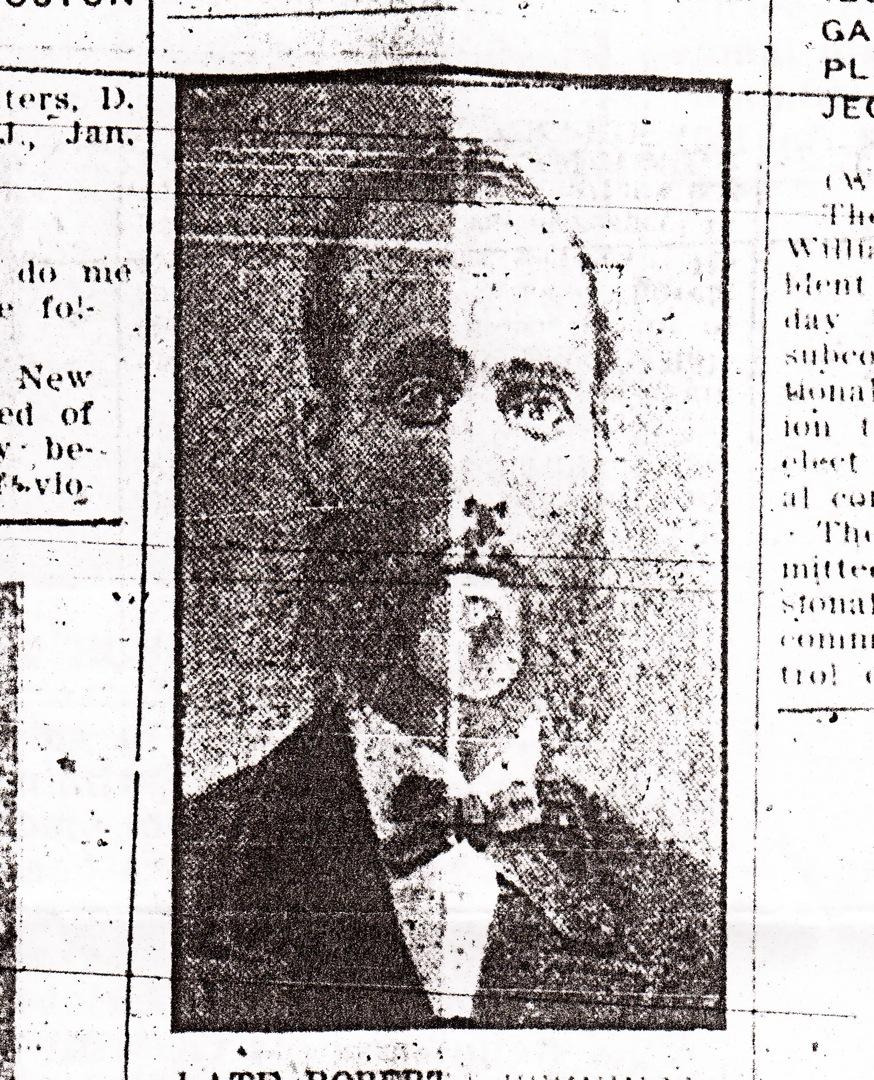
My great-great grandfather Robert Williamson Hemmings (1841-1908), as he looked c. 1886.
Jill looks at Boston Brahmins, the White Anglo Saxon Protestant class, and their ordered-up caste structure of the 19th century in the context of the Hemmings family, and their friends, who made up what sociologist Adelaide Cromwell termed: “The Other Brahmins.”
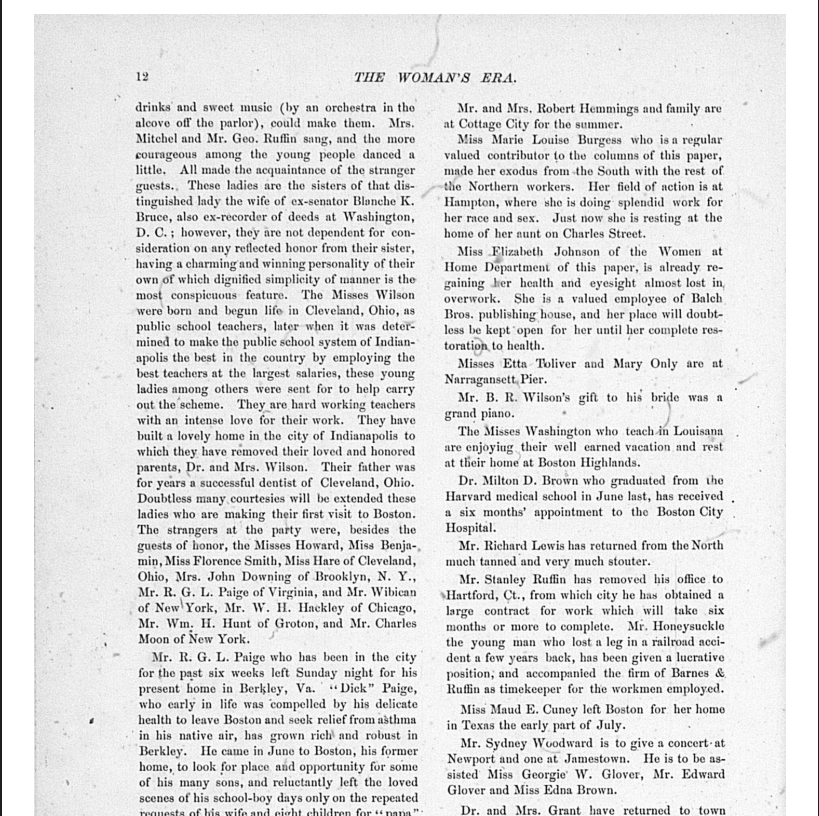
Social doings of the family, top right, and the people they knew. A page out of Josephine St. Pierre Ruffin’s Woman’s Era magazine.
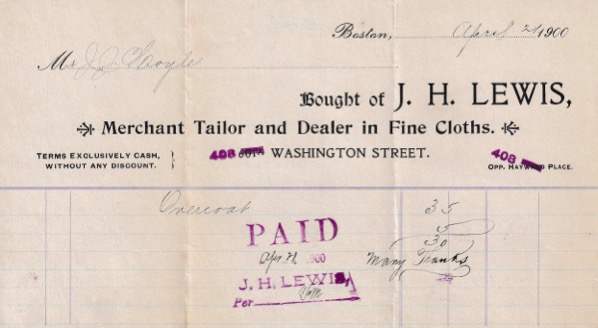
Original store receipt for J.H. Lewis, tailor, close friend of the Hemmingses.
Attributions
The Boston Guardian, Boston, MA, January 14, 1908. A thousand thanks to the late Neil B. Todd, who mined three separate repositories trying to find the best quality reproduction of Robert’s picture.
Boston city voter data, also courtesy Neil B. Todd.
Descriptions of Robert Hemmings: Boston Globe, Boston, MA, August 16, 1897 and New York World, New York, NY, August 16, 1897.
Dora Hemmings passed later in life: she and her adult children, Elizabeth and Frederick, living with her, were all listed as “white” on the 1930 census return for Boston. Year: 1930; Census Place: Boston, Suffolk, Massachusetts; Roll: 949; Page: 15A; Enumeration District: 0319; Image: 282.0; FHL microfilm: 2340684. National Archives and Records Administration (NARA) and Ancestry.com.
Descriptions of Dora’s appearance and character: The Boston Globe, Boston, MA, August 16 and 22, 1897.
“City upon a hill” originates in the Bible and was used in the 1630 sermon “A Model of Christian Charity,” delivered to the Puritan immigrants on the ship Arbella, by future Massachusetts Bay Colony governor John Winthrop, who saw the future colony as a paragon of human civilization: “We shall be made a story and a by-word through the world.”
“Because of imperfectly established connections with a First Family, can never hope to become Proper Bostonians” from Amory, Cleveland. The Proper Bostonians (Orleans, MA: Parnassus Imprints, 1984), p. 13.
Profile of genealogically minded Puritan New England in Fischer, David Hackett. Albion’s Seed: Four British Folkways in America (New York: Oxford University Press, Inc., 1989).
1881 edition of Clark’s Boston Blue Book (Edward Clark, publisher, 1881 edition). Internet Archive. https://archive.org/details/clarksbostonblue1881bost/page/n3/mode/2up.
Newport representing a “fury of fashion” in Amory, Cleveland. The Proper Bostonians (Orleans, MA: Parnassus Imprints, 1984), p. 199.
Descriptions of Beverly, MA in Garland, Joseph E. The North Shore: A Social history of Summers Among the Noteworthy, Fashionable, Rich, Eccentric, and Ordinary on Boston's Gold Coast (Beverly, MA: Commonwealth Editions, 1998). Internet Archive. https://archive.org/details/northshoresocial0000garl. Last accessed 18 Mar. 2025.
Robert Hemmings is listed in the Beverly City Directory, 1875. Ancestry.com.
Structures of meaning for the Hemmings family in Boston’s Back Bay include Trinity Church, the Museum of Fine Arts, the Massachusetts Institute of Technology, and, after 1895, the Boston Public Library, where Anita Hemmings would work as a cataloguer.
“[T]hey all worked very, very hard to get away from where they’d come from. They were all extraordinary.” Direct quote of Barbara Love during a telephone call with Jill Sim, January 1, 1998.
Dressmaking business of Phoebe Whitehurst Glover described in Mitchell, Vernor D. and Cynthia Davis. Literary Sisters: Dorothy West and Her Circle, A Biography of the Harlem Renaissance (Rutgers University Press, 2011), p. 70.
“One of the things which colored society had in common with the upper-class whites was that almost every prominent colored family of the time had certain members who were outstanding in educational achievements.” from Stevens, Walter J. Chip on My Shoulder (Boston: The Meador Press, 1946), p.80.
Senior member of the ‘Old Guard’ remembering his boyhood catching insults from white people if he moved beyond the boundaries of his neighborhood. See Cromwell, Adelaide M. The Other Brahmins (Fayetteville: The University of Arkansas Press, 1994), p. 228.
Odd Fellows Hall and other fraternal societies were segregated in Boston: Daniels, John. In Freedom’s Birthplace (New York: Arno Press and the New York Times, 1969), p. 208.
African Americans “created a lifestyle unexcelled” after the Civil War, in Cromwell, Adelaide M. The Other Brahmins (Fayetteville: The University of Arkansas Press, 1994), p.53
“Black aristocrats” described in Gatewood, Willard B. Aristocrats of Color: The Black Elite, 1880-1920 (Bloomington & Indianapolis: Indiana University Press, First Midland Book Edition, 1993), pp. 110-112.
“Coated waiters” in Cromwell, Adelaide M. The Other Brahmins (Fayetteville: The University of Arkansas Press, 1994), p. 55.
Brigham’s Hotel and Restaurant at the corner of Washington and Essex in Downtown was the only restaurant that reliably served Boston’s African Americans. Cromwell, Adelaide M. The Other Brahmins (Fayetteville: The University of Arkansas Press, 1994),p. 228; also see: Boston and Bostonians (New York: American Publishing and Engraving Co., 1894). Internet Archive. https://archive.org/details/bostonbostonians00amer/page/n11/mode/2up.
Boston’s black high society overlapped with black social and political spheres in other cities with black upper classes, like Philadelphia, New York, and Washington, D.C. See Taylor, Elizabeth Dowling. The Original Black Elite: Daniel Murray and the Story of a Forgotten Era (New York: Amistad, 2018), p. 69.
“A Remarkable Woman.” Obituary for Harriet Peake Lewis. Boston Evening Transcript, Boston, MA, March 15, 1902. Newspapers.com.
The 54th and 55th Massachusetts were the famed “Glory” regiments paid tribute in the 1989 war drama Glory. Black Bostonians were known for ardent patriotism and special devotion to Boston’s war heroes (Revolutionary and Civil) and martyrs, such as Robert Gould Shaw, who led the African American 54th Regiment and died and is buried alongside the troops of the 54th, at Fort Wagner, Morris Island, South Carolina. Black Boston aided in the planning and funding of sculptor Augustus Saint-Gaudens’ bronze memorial for Robert Gould Shaw and the 54th Regiment on the Boston Common.
Please view an image of the memorial at the National Art Gallery website: https://www.nga.gov/artworks/102494-shaw-54th-regiment-memorial
In 1904, close Hemmings family friend and journalist/editor Robert Teamoh (1864-1912) wrote for the Boston Globe newspaper in the late 19th century.
Robert Teamoh’s column in the Boston Globe newspaper and Josephine St. Pierre Ruffin’s magazine The Woman’s Era give us a rare window into the vanished world of ‘The Other Brahmins.’
“The Battle Hymn of the Republic” was written by abolitionist Julia Ward Howe and set to a marching song called “John Brown’s Body.” “John Brown’s Body” in turn was originally composed to mock a Scotsman of the Massachusetts Volunteer Militia, who had the same name as John Brown, the radical abolitionist martyr. With its iconic ‘Glory, glory, hallelujah’ refrain, this Civil War anthem inspired the name of the 54th and 55th “Glory” units raised in Boston, and later provided the title for John Steinbeck’s novel set in the Great Depression, The Grapes of Wrath.
Josephine St. Pierre Ruffin’s name as synonymous with Susan B. Anthony in the name of suffrage and women’s emancipation. Stevens, Walter J. Chip on My Shoulder (Boston: The Meador Press, 1946), p. 46.
According to historian Lerone Bennett Jr., 1,217 African Americans were lynched between 1890 and 1900. Bennett, Jr., Lerone. Before the Mayflower: A History of Black America (New York: Penguin Books, 1988. Sixth edition), p. 271.
Issues of Josephine St. Pierre Ruffin’s Women’s Era: The Women’s Era, Volume One, 1894-1897. Women’s Era Club, pub. Electronic Edition. Emory Women Writers Resource Project. http://womenwriters.digitalscholarship.emory.edu/advocacy/toc.php?id=era1.
Ruffin’s rhetorical question “Which race?” quoted in Lewis, David Levering. W.E.B. DuBois: Biography of a Race (New York: Henry Holt and Company, Inc, 1993), p. 104.
“[T]hese old ‘genteel’ families sought to preserve their traditions by withdrawing from the competition with the new professional classes in the Negro community. In their quiet, obscure lives they expressed often their contempt for the black upstarts who, in their view, and often in fact, possessed neither morals nor manners.” – from Frazier, E. Franklin. Black Bourgeoisie (London: Collier Books, 1969 ed.), pp. 99-100.
Sketch of the successful tailor and Hemmings family friend, J. H. Lewis, in Hayden, Robert C. African Americans in Boston: More Than 350 years (Boston: Trustees of the Public Library of the City of Boston, 1991), 78.
Note: J.H. Lewis not only purchased the plantation where he was enslaved as a child, he also established a school for black children on the land. Here’s an excellent, recent profile on Lewis, courtesy a Trinity Church historian, Cynthia Staples: https://trinitychurchboston.org/from-the-historian-a-story-of-fine-tailoring-john-h-lewis/
The inventive Benjamin family, and the rumor and recollection of the white chauffeur was given by Lyde Benjamin’s granddaughter, Barbara Hale, interviewed in the Pittsburg Press, March 3, 1981. Pg. 8. Newpapers.com. Also see: Neal, Anthony W. “Edgar P. Benjamin: Philanthropist, Noted Attorney and Banker,” Bay State Banner, March 28, 2013. https://baystatebanner.com/2013/03/28/edgar-p-benjamin-philanthropist-noted-attorney-and-banker/. Last accessed 13 Sept. 2021.
Entry on Miriam Benjamin at the African American Registry. https://aaregistry.org/story/miriam-benjamin-inventor-born/. Accessed 13 Sept. 2021.
Coverage of an evening reception for a pianist visiting Boston from Cleveland gives a typical listing of the names of people with whom the Hemmingses regularly socialized. The Boston Globe, July 20, 1898, pg. 3. For more on inventor Joseph Lee, see: National Inventors Hall of Fame entry on Lee at: https://www.invent.org/inductees/joseph-lee and also see: blackinventor.com.
Information on Louis Garbe, buried in the Hemmings family burial plot : “Louis E. Garbe.” Suffolk County, Massachusetts, Probate Records, 1886-1887. Familysearch.org; and: Virgin Islands Social History Associates (VISHA). U.S. Virgin Islands Census, 1835-1911 (Danish Period). Ancestry.com; and: “Maria S. Olsen Will.” Suffolk County, Massachusetts, Probate Records. Familysearch.org
Images
Portrait of Robert Hemmings from his obituary, on the front page of the Boston Guardian newspaper, January 14, 1908. The best reproduction Neil Todd could find was from Williams College. The original portrait from which it was taken is lost.
Josephine St. Pierre Ruffin’s The Woman’s Era magazine, Vol. 1, No.5, August, 1894. Twenty two issues of the magazine have been preserved, digitized and transcribed, at the Emory Center for Digital Scholarship of Emory University. See: https://womansera.digitalscholarship.emory.edu/#gsc.tab=0
Store receipt for J.H. Lewis’ tailoring business. Personal collection of Jill Sim, acquired through a collector of antiques.
Original Music by Al Sim
"Cold Case Blues"
"Mystery 3"
Royalty Free Music
Courtesy MusOpen:
Nikolai Rimsky-Korsaakov: Scheherazade: "The Young Prince and the Young Princess"
Johann Strauss: "Blue Danube Waltz"
Claude Debusssy: "Danse Sacrée et Danse Profane"
Frederic Chopin: "Mazurka in A Minor," Op. 17 No. 4
Camille Saint-Saens: Le Carnaval des Animaux: "Le Coucou au fond des Bois"
Antonin Vivaldi: "Violin Concerto in F Minor," or "The Four Seasons: Winter. Allegro non Molto."
Courtesy Pixabay:
(No Artist Found) : “Cinematic Ambient”
I Fisher : “Silent Waves-Instrumental”
Luis Humanoide : “Victorian Violin Waltz“
Scott Joplin: “Bethena” - Midi, D.M. Unlimited Free Music. See: https://www.youtube.com/watch?v=X6IuKmf3xrU
Vassar: Show Notes