Vassar: Show Notes
Attributions
Coverage of Anita Hemmings at Vassar is taken from period newspapers found at the Boston Public Library, the Chronicling America newspaper database at the Library of Congress, Newspaperarchive.com and Newspapers.com.
“Irreproachable moral character.” — Evening Messenger, St. Albans, Vermont, August 19, 1897.
“[F]rail, retiring, industrious”; “manners faultless, her carriage superb, and she swept away with gracious ease the barriers of exclusiveness that surround the homes of […] aristocratic […] people.” — Providence Journal, Providence, RI, August 17, 1897.
The “beautiful brunette” and “Yale and Harvard men [were] among those who sought favor with the ‘brunette beauty.’”— New York World, New York, NY, August 16, 1897.
“Known throughout the east as an inspired teacher with the eternal enthusiasm of youth, Professor Wylie was not a remote academic type but a woman who bridged the gap between campus and town with myriad activities." — “Laura Johnson Wylie,” Vassar Encyclopedia, http://vcencyclopedia.vassar.edu/faculty/prominent-faculty/laura-wylie.html. Accessed 28 Aug. 2019.
“Anyone who remembers the beginning of the famous ‘nineties’ will realize what public opinion about the decent young lady was at that time. They will also realize what a job it was to take that long-skirted-wasp-waisted, clinging vine [sic] individual and put her upon the gymnasium floor in bloomers.” — Poughkeepsie Eagle-News, Poughkeepsie, NY, May 20, 1930.
Vassar was an institution which “[I]mparted the most perfect education of body, mind, and heart.” — Taylor, James Monroe, and Elizabeth Hazleton Haight. Vassar (New York: Oxford University Press, 1915), p. 211.
Coverage of the Elizabeth Baker William-Henry Lewis wedding: The Boston Globe, Boston, MA, September 23, 1896.
Community conflict over Pelton’s Pond in Poughkeepsie: Flad, Harvey K. and Clyde Griffen. Main Street to Mainframes: Landscape and Social Change in Poughkeepsie (Albany: State University of New York Press, 2009).
[…] investigation failed to find the culture and wealth and old family name of which she boasted. The family name to be sure was the same, but the family!—well the only person of that name in the place is a ‘gentleman of color;’ his business is that of caring for a department under the city government similar to that which has agitated the Board of Health in Poughkeepsie, and which the Courier first brought to the notice of the public. This information was communicated to the roommate by her father, and, acting upon his advice, under some pretext quietly secured another room. — Poughkeepsie Courier, Poughkeepsie, NY, Aug 22, 1897.
“The 500 and odd students whispered each 500 and odd little tales”. — Providence Journal, Providence, RI, August 18, 1897
Elizabeth Baker Lewis interviewed about her friend Anita in “Vassar’s Dark Beauty.” Minnesota Star Tribune, August 26, 1897.
A professor was reported as saying: “There must be Spanish tendencies in your family to have such a [first] name.” To which Anita Hemmings apparently replied, “No, there is no Spanish blood in me.” — Poughkeepsie News-Press, Poughkeepsie, NY, August 17, 1897.
Anita quoted as saying: “You have learned what I did not tell you. You know that my parents are colored people.”— Poughkeepsie News-Press, Poughkeepsie, NY, August 17, 1897.
She cried, “as if her heart would break.”— Providence Journal, Providence, RI, August 18, 1897.
“[The faculty] considered the matter gravely. Never had a colored girl been a student at aristocratic Vassar, and professors were at a loss to foresee the effect upon the future if this one [was] allowed to be graduated. Yet there [was] nothing in the college rules that prohibit[ed] a colored woman from entering Vassar.“ — The World, New York, NY, Aug, 16, 1897.
Note on “Easter Song” from Jules Massenet’s opera Le Cid, which Anita performed. See Vassar Miscellany. Vol. XXVI, Number 9, June 1, 1897.
I looked at past and present repertoires for Le Cid and couldn’t find an “Easter Song” listed anywhere. It may be an alternative name for one of the elaborate, difficult, pieces to be sung by a soprano soloist, or the program may have been wrong. There was an “Easter Hymn” from the opera Cavalleria Rusticana, 1890, described as an international “sensation,” composed by Italian Pietro Mascagni, which required a soprano. It is florid and technically very difficult, befitting Anita’s training and ability, and reflecting her taste in opera.
“She was a fascinating woman, and professors and students and strangers alike fell under the charm she exercised […] the girls began to eye her curiously, wonderingly. She knew that they were commenting, discussing. There was bitterness beyond words in this, to the proud sensitive woman […] To them she was merely a creature to be discussed as a problem.” — The Buffalo Voice. December 11, 1897. Chronicling America. Library of Congress.
Statement of Elizabeth Baker Lewis: Miss Hemmings is entitled to all the honor of having obtained her education at Vassar, which has not reflected an atom of disgrace upon that college, nor upon any other pupils. She is good and true, brilliant in many things, refined and always lady-like in her actions. Her reception at college tells the story in itself. They loved her, no matter what you may hear. She is an honor to her race and an honor to Boston. Because her face did not tell her secret why should she go about placarded, ‘I am colored,’ or for that matter, what difference could color make to one like Miss Hemmings, who could enter society and be not only an ornament, but prove her wealth and refinement?— “Beautiful Anita Hemming.” The Sacramento Daily Record-Union. September 24, 1897. Chronicling America. Library of Congress.
Robert Hemmings quote: “We know our daughter went to Vassar as a white girl and stayed there as such. As long as she conducted herself as a lady, she never thought it necessary to proclaim the fact that her parents were mulattoes.”— Boston Courier, August 22, 1897
Also Robert Hemmings: “She never told them […] We know she went there as a white girl and she remained as such.” — The Boston Globe, August 18, 1897.
“Vassar is referred to as an aristocratic and exclusive institution of learning and much solicitude is expressed in regard to the future of the college once it is generally known it has been disgraced and degraded by the education and graduation of a woman with colored blood in her veins.” — St. Alban’s Daily Messenger, St. Alban’s Vermont, August 19, 1897.
Screed excerpt of Paul Laurence Dunbar: “Enormous papers of the metropolis, exponents of the opinions of a cosmopolitan city, came out with glaring headlines above sensational columns! And all because a colored young woman, too fair to be recognized as one with African blood, had graduated from Vassar! Well, what of it? What a theme to raise a tempest about! […]
Had she hurt Vassar or her schoolmates? Did her dark blood have any virus in it which could inoculate those who came into contact with her? Would anybody but an American teeming with narrowness and prejudice have thought twice about the matter?
Would a Frenchman, an Englishman or a German have said […] that ‘she was graciously permitted as a favor to take equal rank with the members of her class’?
Graciously permitted to do what was her right! Graciously, fiddlesticks! […]
‘The president himself advised that at so late a day no official action be taken to prevent the girl from graduating with her classmates.’ Official action! What for? One would think that some crime had been committed. […].”
— “The Vassar Case.” The Gazette, Cleveland, Ohio. September 11, 1897. Digitized at the Chronicling America site of the Library of Congress. https://www.loc.gov/collections/chronicling-america/.
“Woodpile Story” — Vassar Miscellany, Volume XXVI, Number 8, 1 May 1897.
Note: Sutematsu Yamakawa, also known as Princess Oyama, class of 1882, was the first Japanese woman to receive a college degree, and is considered one of Vassar’s first students of color. She died in 1919 from the 1918 Influenza pandemic.
My grandmother Ellen quoted: “I am eternally grateful for the years I spent at Vassar College. The disciplines acquired in study and the development of inner resources has been invaluable to me […] It is my fervent hope that my grand-child, Jillian, will be able to avail herself of all the beauty and wonder of Vassar College that my mother and I loved.” — From the 1976 Reunion Bulletin, Vassar College Special Collections.
Special thanks to Dr. Joyce Bickerstaff, professor, Africana Studies, Vassar, for her gracious hospitality at Vassar and on Martha’s Vineyard.
Images
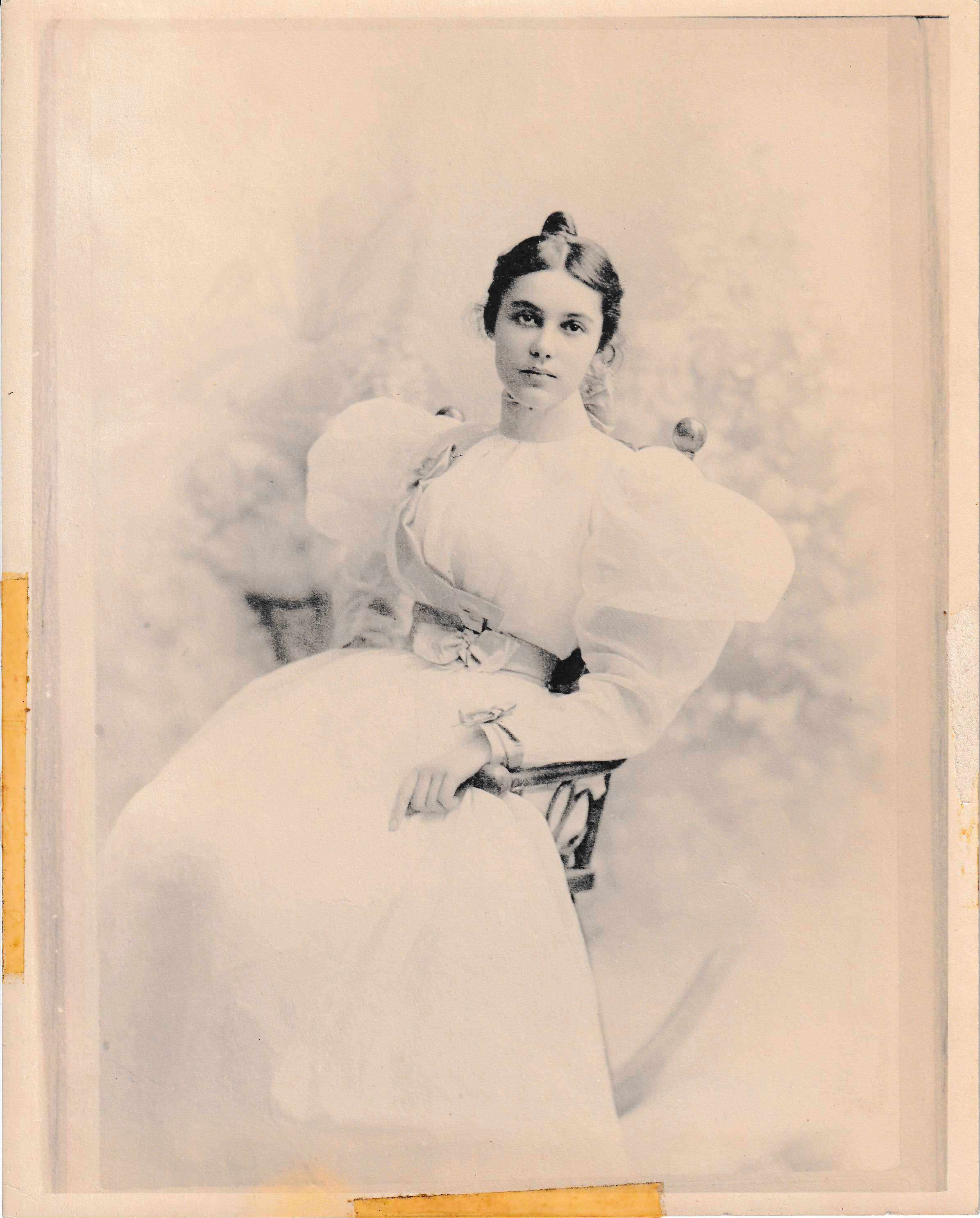
Original portrait of Anita Hemmings was part of a collection of photographs that belonged to Ellen Love and was placed in storage and uncovered several years after Jill’s visits to Vassar College.
This portrait is the exclusive property of Jill Sim and may not be duplicated or reproduced.
Music
Original Music by Al Sim:
"Mystery 3:" three versions in English Harpsichord, Italian Harpsichord, and Harp and Bass.
Courtesy MusOpen:
Handel: Zadok the Priest
Franz Liszt: Adagio No. 3 from Piano Pieces, S. 192.
Wolfgang Amadeus Mozart: String Quartet No. 19 in C Major, K 465. Or known as the “Dissonance” Quartet.
Monteverdi, L’Orfeo, Prosperina: “Signor Quel Infelice,” vocalist, Anna Simboli.
Camille Saint-Saëns: Carnival of the Animals (Carnaval des Animaux): VII. Aquarium (Aquarium); IX. The Cuckoo in the Deep Woods (Le Coucou au Fond des Bois); XII. Fossils (Fossiles)
Vivaldi: Violin Concerto in F Minor (The Four Seasons) “Winter”; and Cello Sonata No. 5 in E Minor, Opus 14, Largo, Mov. 3.
Brahms: Symphony No. 2 in D Major, Op. 73.
Internet Archive:
Al Bowlly, “The Very Thought of You,” Ray Noble and His Orchestra, Electrola, London, 1934, 78 RPMS and Cylinder Recordings.
Note: Uncle Andy Love joined the Ray Noble Orchestra for a series of engagements at the Rainbow Room in New York City. Ray Noble and Al Bowlly are perhaps best known for their song “Midnight, the Stars and You” featured in the horror movie The Shining. Al Bowlly was sadly killed in 1941 by a mine explosion during heavy bombing of London in World War Two.
Other:
Midi score, Arthur Sullivan, W.S. Gilbert: Comic Opera Mikado, “Three Little Maids from School.”