Boston Trinity: Show Notes
Jill Sim looks at family connections to Boston Brahmin religious circles, and a segregated church culture during the period of rapid change given by immigration waves to Boston.
Within the complexities of a family’ of color’s tenuous standing in the shifting society, anti-Catholic and Irish sentiments simmer beneath ardent values of equity.
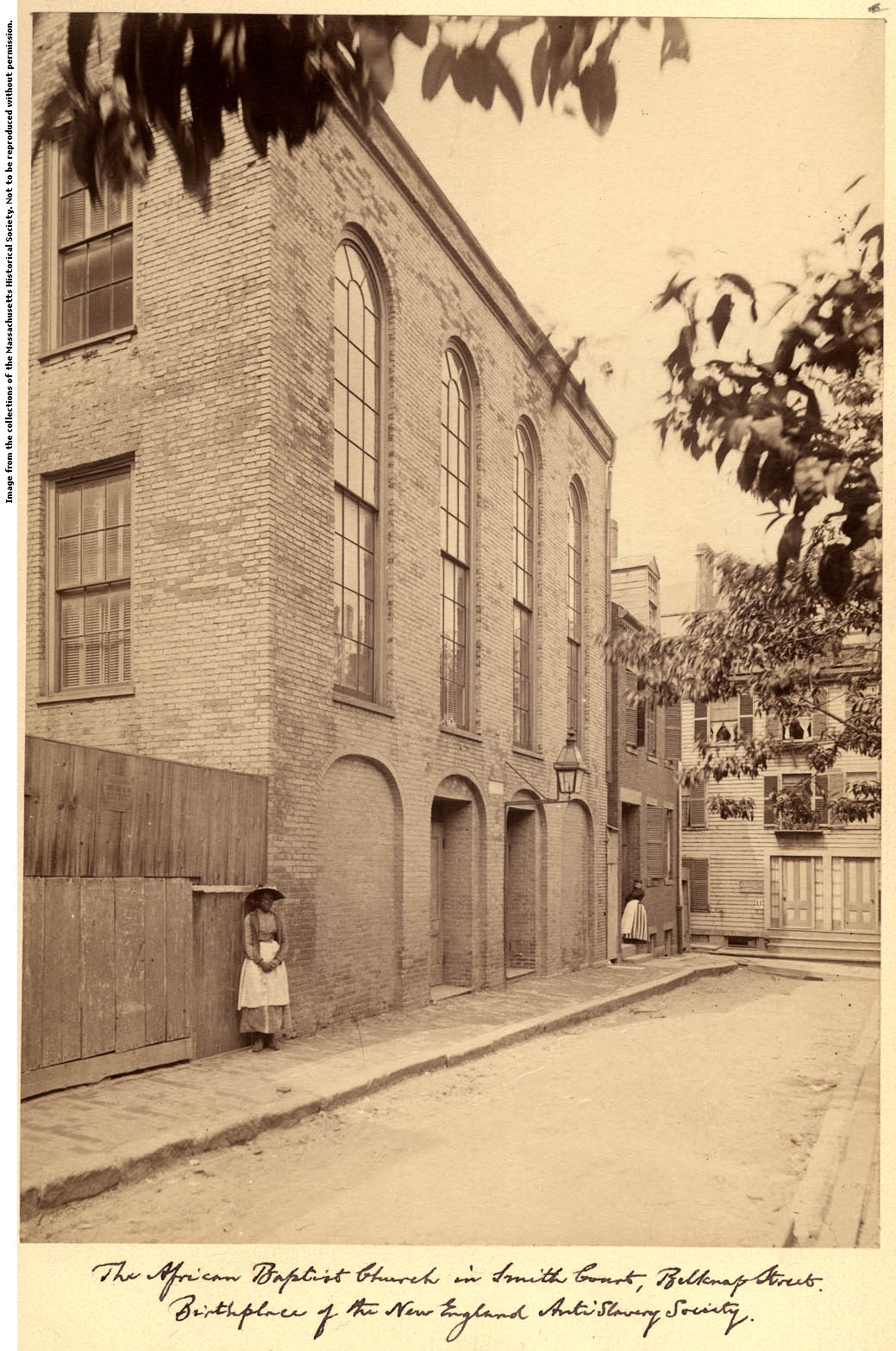
The African Baptist Church (1806), and the Beacon Hill quarter of Boston, where the Hemmings family settled in 1872, after leaving the Shenandoah Valley of Virginia.
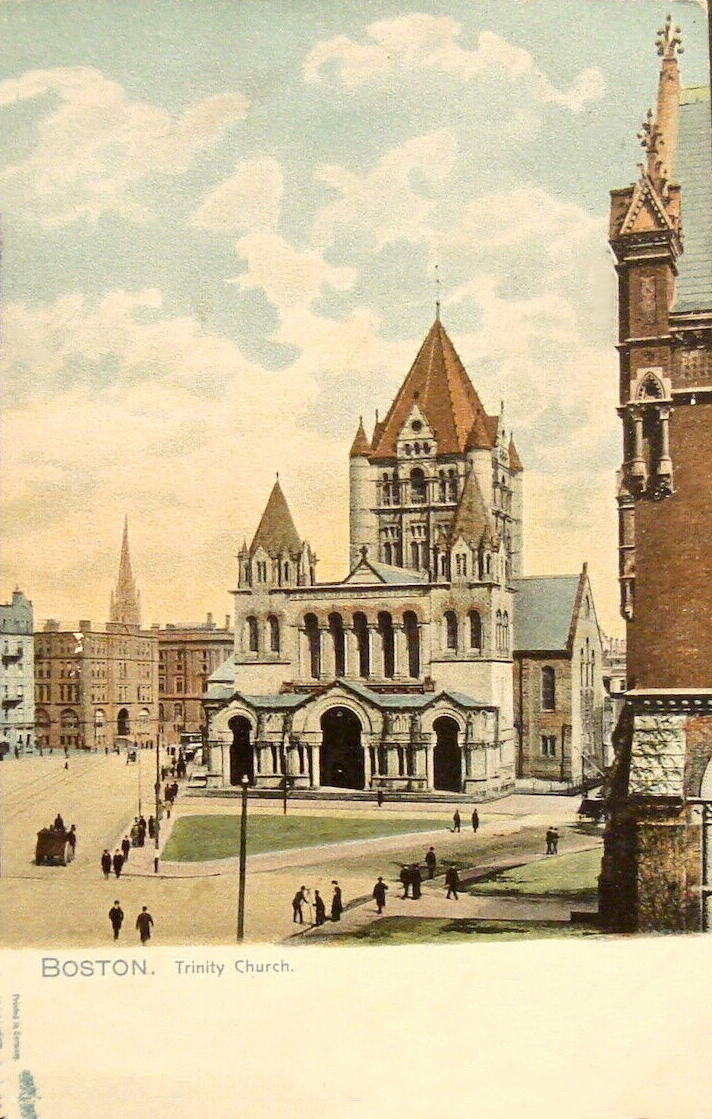
Postcard of Trinity Church (1877), 206 Clarendon Street, Copley Square, Boston, where the Hemmingses worshipped with white Brahmins under the spiritual leadership of the great Rev. Phillips Brooks (1835-1893).
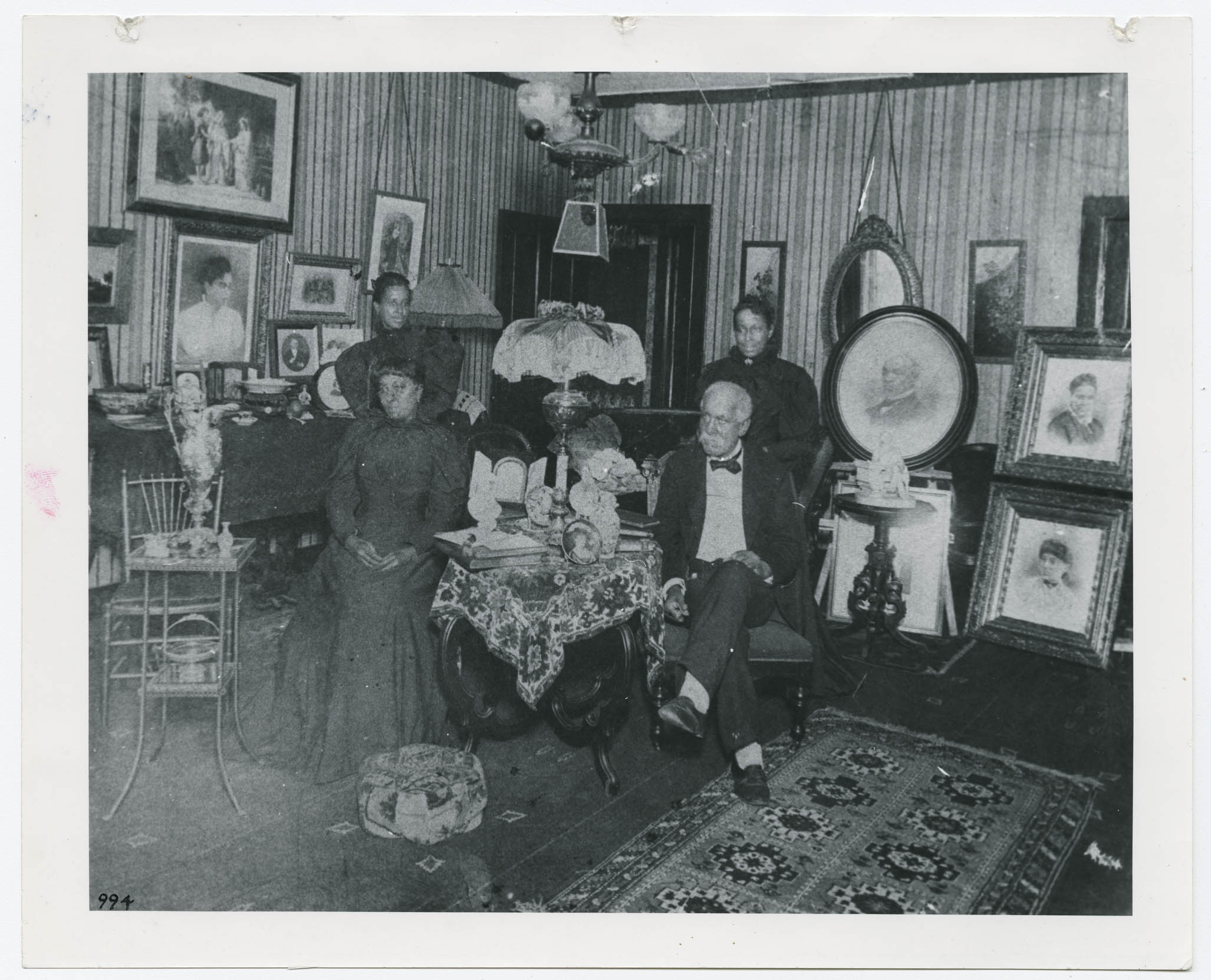
George Thomas Downing (1819-1903), Abolitionist, Restauranteur, Hotelier, Real Estate Mogul. Downing Led the Desegregation of Public Schools in Rhode Island. Family Portrait taken in the Downing Parlor, c. 1890, State Street, Newport, Rhode Island.
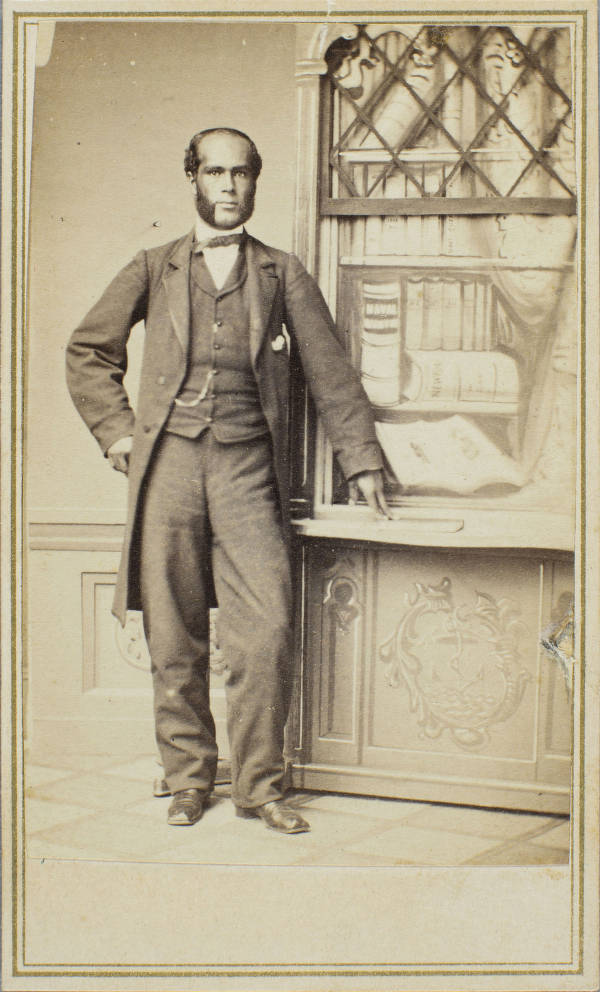
Mark Rene De Mortie (1829-1914), Abolitionist, Active in Boston’s anti-slavery Vigilance Committees; Sutler for the 54th Massachusetts Regiment During the Civil War; Son-in-Law of George Thomas Downing; Close Family Friend of the Hemmingses.
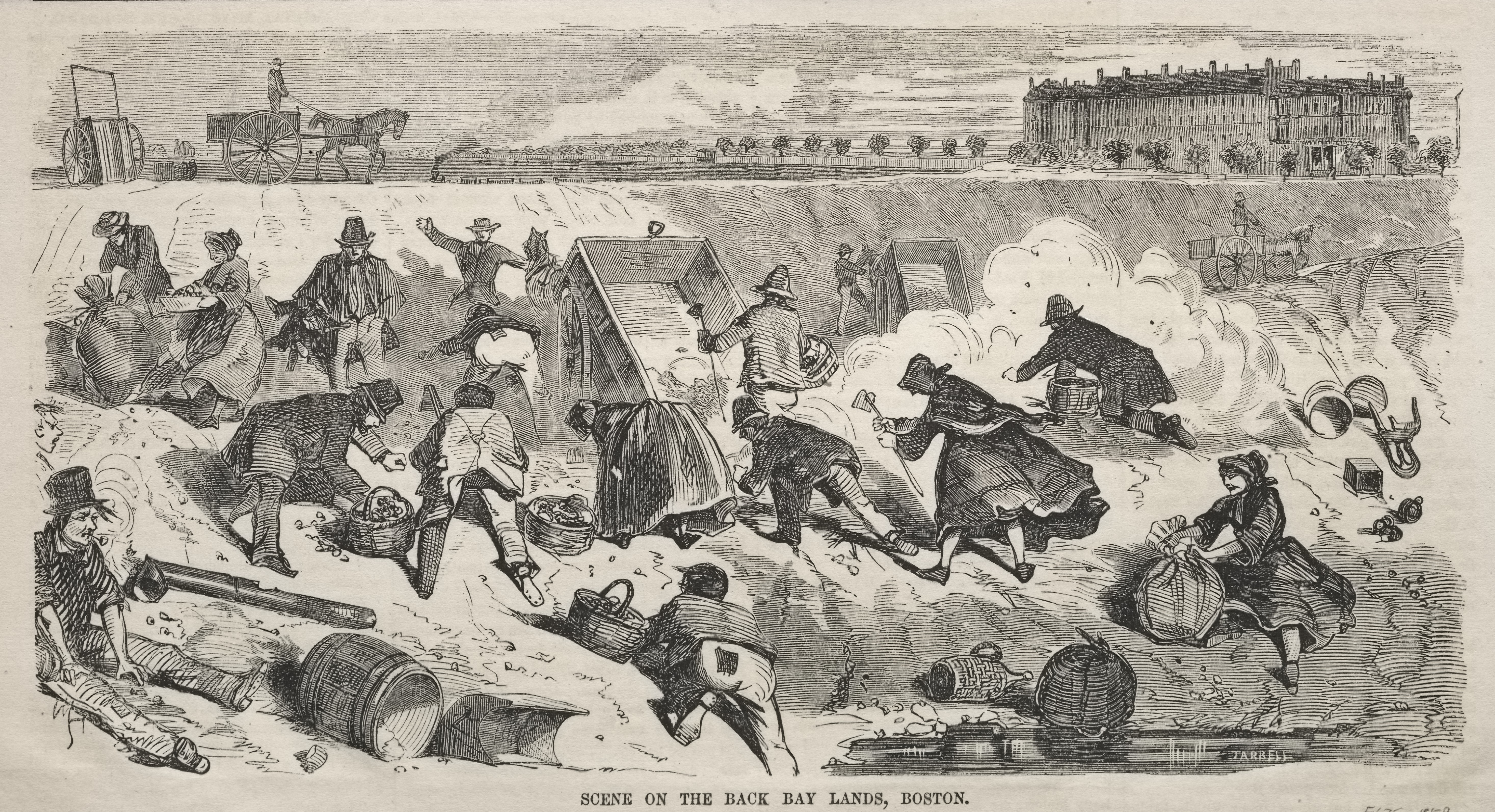
Irish Immigrant Laborers Filling in Tidal Marsh to Create Boston’s Back Bay, whom Anita Hemmings referred to as “The Muckers”
Attributions
“Religious life of the Negroes” quoted in Daniels, John. In Freedom’s Birthplace (New York: Arno Press, 1969), pp. 224-265.
Short biography of Leonard Grimes at the Boston African American Historical Site; New Bedford Whaling National Historic Park. https://www.nps.gov/people/leonard-grimes.htm
For an in-depth account of 19th century politics and Black Boston, please refer to the superlative scholarship of Schneider, Mark R. Boston Confronts Jim Crow (Boston: Northeastern University Press, 1997). And: Bergeson-Lockwood, Millington W. Race Over Party: Black Politics and Partisanship in Late Nineteenth-Century Boston (Chapel Hill, University of North Carolina Press, 2018)
On Robert Treat Paine, see: Paine, Thomas M. “Chairman of the Building Committee: Robert Treat Paine,” in James F. O’Gorman, ed. The Makers of Trinity Church in the City of Boston (The University of Massachusetts, 2004).
Note: I contacted an archivist at the Robert Treat Paine Stonehurst Estate museum, to inquire after employee records, hoping to find evidence of Robert’s driving for Paine, given the connection to Trinity and Paine’s philanthropy enabling my family to buy their first home, but there was no record of Robert Hemmings working in the Paine archives. Please visit: https://stonehurstwaltham.org/
Robert Treat Paine and family members were actively involved with Virginia’s Hampton Institute, and later, Booker T. Washington’s Tuskegee College, a normal and vocational school, which provided teacher’s and occupational skills training in Alabama.
“Mother just worshipped [Phillips Brooks]. To understand [Anita], you must understand him.” From May 14, 1999 telephone call between Jill Sim and Barbara Love.
Black soldiers and the Spanish-American War: Pullen, Frank W. “A Perfect Hailstorm of Bullets”: A Black Sergeant Remembers the Battle of San Juan Hill in 1899, from: Johnson, Edward A. History of Negro Soldiers in the Spanish-American War (Raleigh, 1899), 29–32. Reprinted in Katz, William Loren. Eyewitness: The Negro in American History (New York: Pittman Publishing, 1967), 383–384. History Matters. https://historymatters.gmu.edu/d/100/.
And: “Buffalo Soldiers in the Spanish-American War: Charles Young Buffalo Soldiers National Monument.” National Park Service. https://www.nps.gov/articles/000/busospanamwar.htm
Guy Hamilton Scull: Case, Henry Jay. Guy Hamilton Scull: Solider, Writer, Explorer and War Correspondent (New York: Duffield & Company, 1922). Uploaded in 2008 by Alyson-Wieczorak of the University of California Libraries, and available at the Internet Archive. https://archive.org/details/guyhamiltonscull00case.
“Sharp Words: Councilor-Elect I.B. Allen Used Them.” The Boston Globe, Boston, MA, December 3, 1896. Pg. 1.
Mugwumps and the election of 1884, George T. Downing’s support for Irish independence, chronicled in Bergeson-Lockwood, Millington W. Race Over Party: Black Politics and Partisanship in Late Nineteenth-Century Boston (Chapel Hill, University of North Carolina Press, 2018).
The origins of the ‘Know Nothing’ political party name allegedly came from the response “I know nothing,” to any inquiries regarding this secretive group’s meetings, membership, and party activities.
Journalist Timothy Thomas Fortune drawing parallels of enslavement history between Irish and African Americans in Osofsky, Gilbert. “Abolitionists, Irish Immigrants, and the Dilemmas of Romantic Nationalism.” The American Historical Review, vol. 80, no. 4, 1975, pp. 889–912. JSTOR, www.jstor.org/stable/1867443. Accessed 8 Jan. 2020.
Robert Morris: William Leonard. “Black and Irish Relations in Nineteenth Century Boston: The Interesting Case of Lawyer Robert Morris.” Historical Journal of Massachusetts. Volume 37, No. 1 (Spring 2009). Retrieved from HJM's online archive at http://www.westfield.ma.edu/mhj.
Immigrant Irish population numbers: Hayden, Robert C. African Americans in Boston: More Than 350 Years (Boston: Trustees of the Public Library of Boston, 1991), p. 19.
Note: Boston elected its first Irish Catholic mayor in 1884, while Boston only saw her first black ‘acting’ mayor in 2021.
Recollections of Irish immigration to Beacon Hill and African Americans removing to Boston’s South End, in Stevens, Walter J. Chip on My Shoulder (Boston: The Meador Press, 1946).
Images
African Meeting House. Photograph, c. 1892. From William Lloyd Garrison, 1805-1879: The Story of His Life, Volume I, Part II, by Wendell Phillips Garrison, (NY, 1885), extra illustrated edition, image opposite page 280. The image also features handwritten caption: "The African Baptist Church in Smith Court, Belknap Street. Birthplace of the New England Anti Slavery Society."’ The Collection of the Massachusetts Historical Society. https://www.masshist.org/database/1684
Portrait of George T. Downing and Family (c. 1885). From the DeGrasse-Howard Photographs Collection. The Collection of the Massachusetts Historical Society. Boston, Massachusetts. https://www.masshist.org/database/viewer.php?item_id=5971&img_step=1&br=1&mode=large#page1
Note: George T. Downing was married to Serena DeGrasse, from a prominent, landowning family of color of New York City. Serena’s father was allegedly born in India, the son of a woman from Calcutta, and a French military officer. https://www.wikitree.com/wiki/DeGrasse-73
Mark Rene DeMortie, Carte de Visite, 1860-1870. Joshua A. Williams, Photographer, Newport, Rhode Island. Harriet Hayden Albums. Courtesy, Boston Atheneum, Boston, Massachusetts. https://cdm.bostonathenaeum.org/digital/collection/p16057coll52/id/63/rec/2
Note: Interesting provenance, noted by archivists at the Boston Atheneum: One of two Harriet Hayden cartes de visite albums was passed to Boston lawyer Robert Morris, and then to civil rights activist William Monroe Trotter, who provided annotations identifying the sitters in both.
“Scene on the Back Bay Lands, Boston,1859.” Winslow Homer (American, 1836–1910). Wood engraving; The Cleveland Museum of Art, Purchase from the J. H. Wade Fund 1942.1380. Internet Archive. https://archive.org/details/clevelandart-1942.1380-scene-on-the-back-ba
Sermons of Rev. Phillips Brooks, originally published 1878, digitized by Creative Media Partners, LLC., at the Internet Archive: https://archive.org/details/sermons0000phil_o3w7/page/96/mode/2up
Rev. Brooks urged the wealthy congregants at Trinity to view themselves as stewards of God’s abundance, which drove the era of philanthropic projects in Boston. The mandate was to serve community, and resist enslavement to greed and selfish pride. My family were recipients of such beneficence, especially through Robert Treat Paine, college classmate of Brooks at Harvard, who urged Brooks to lead Trinity Church, and was the lead on the committee to build the Back Bay landmark, after the earlier church building was destroyed in the Boston fire of 1872. Please see: https://trinitychurchboston.org/history/
Rev. Philips Brooks saw 19th century advances in economic theory, and science, to include Darwinism and evolution, as inseparable from an overarching divine plan for human progress.
Music
Original Music by Al Sim:
“The Cigarette Waltz”
“Tension 1A”
“Closing Piano: One”
Courtesy Internet Archive:
The Five Gospel Stirrers: “This Friend of Mine.” Boston Public Library 78 RPM Collection.
John McCormack: “My Irish Song of Songs.” 1921. Boston Public Library 78 RPM Collection.
Courtesy MusOpen:
Claude Debussy: “Clair de Lune”
Ernest Chausson: “Extract from Concerto for Violin, Piano and String Quartet in D, Op. 21 - Ill. Grave”
Courtesy Pixabay:
Alban Gough: “The Star of the County Down”
Music for Creators: “Underwater Current”
Leberch: “Documentary Piano”
Other:
Martin Luther: “Ein Feste Burg ist Unser Gott" or, in English: “A Mighty Fortress is Our God,” a c. 1527 hymn of the Protestant Reformation. Original lyrics taken from Psalm 46. Midi harp file created in GarageBand.