Early Groundwork, Part Two: Show Notes
This episode contains historically racist language that may be offensive for some listeners. Listener discretion is advised.
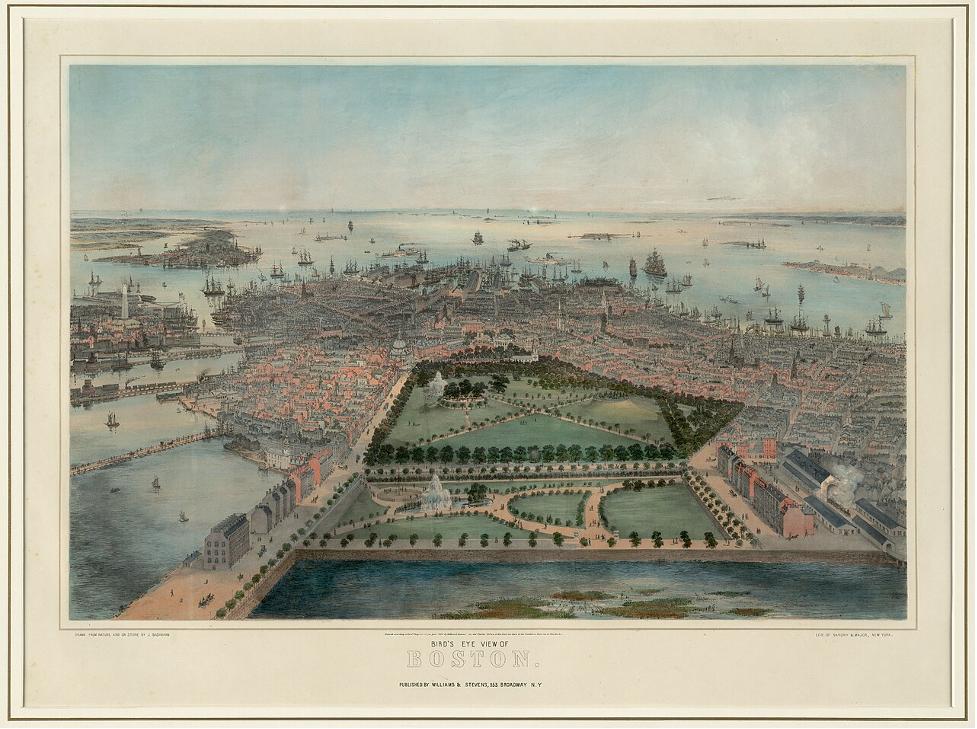
1850 Bird’s Eye View of Boston
Jill continues to dig for evidence of her black relatives and immediately encounters the stumbling block for every researcher of African American families in enslavement: black lives were largely unrecorded and unwritten before the 1870 federal census; the first time people emancipated by the Civil War are listed with full names, ages, and places of birth.
There are problems associated with the fallibility of human memory: names passed down through oral traditions by Jill’s grandmother Ellen, for Anita’s mother and grandmother, do not line up with the paper trail.
Jill decides to try and answer the larger question: why did the Hemmings family chose Boston over other American cities with larger African American populations?
Jill’s explorations of the family’s neighborhood in Boston’s Beacon Hill reveal a long and rich history of the presence of free African Americans; a unique community of people associated with the long struggle for freedom and equality.
|
|
|
|
|
|
Attributions:
Looking for traces of free family in Boyd-Rush, Dorothy A. Register of Free Blacks, Rockingham County, Virginia, 1807-1859 (Bowie, MD: Heritage Books, Inc, 1992).
“Legitimate fruit if freedom” from Jefferson, Israel, and S. Wetmore. "“Life Among the Lowly, No. 3” by Israel Jefferson (December 25, 1873)" Encyclopedia Virginia. Virginia Humanities, (07 Dec. 2020). Last accessed 19 Mar. 2025
Patrick Raymond family: “Boston Colored People.” The Colored American Magazine. Vol 14., No. 1. January 8, 1908. James Weldon Johnson Memorial Collection in the Yale Collection of American Literature, Beinecke Rare Book and Manuscript Library. The Digital Colored American Magazine. Brian Sweeney and Eurie Dahn, Project Directors. https://coloredamerican.org/?page_id=65. Last accessed, 17 Mar. 2025.
Populations of African Americans in Boston: Hayden Robert C. African Americans in Boston: More Than 350 Years (Boston: Trustees of the Public Library of Boston, 1991), p. 19.
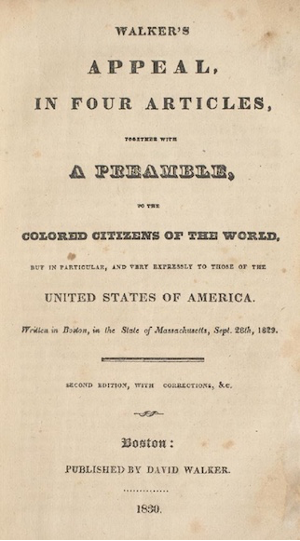
Quotes from David Walker taken from: Walker, David. “Walker's Appeal, in Four Articles; Together with a Preamble, to the Coloured Citizens of the World, but in Particular, and Very Expressly, to Those of the United States of America, Written in Boston, State of Massachusetts, September 28, 1829.” Boston: Revised and Published by David Walker, 1830. Call number VCC326.4 W17a. North Carolina Collection, University of North Carolina at Chapel Hill. Full text at Documenting the American South: https://docsouth.unc.edu/nc/walker/walker.html.
Gabriel’s Conspiracy: Nicholls, Michael. "Gabriel’s Conspiracy (1800)" Encyclopedia Virginia. Virginia Humanities, (07 Feb. 2023). Web. 19 Apr. 2023
Notes on Virginia, more commonly known as Notes on the State of Virginia from Koch, Adrienne and William Peden., eds. “Notes on Virginia” in The Life and Selected Writings of Thomas Jefferson (New York: Random House/The Modern Library 1944).
The nature of ending slavery through “immediatism” in Boston: Brown, Lois. Pauline Hopkins: Black Daughter of the Revolution. The University of North Carolina Press, 2008. 9. And Harris, John. The Boston Globe: Historic Walks in Old Boston. (Chester, CT: The Globe Pequot Press, 1982), p. 67. Note: After slavery was abolished in Massachusetts, in 1783, following the Revolution, many of Boston’s free populations settled in Beacon Hill.
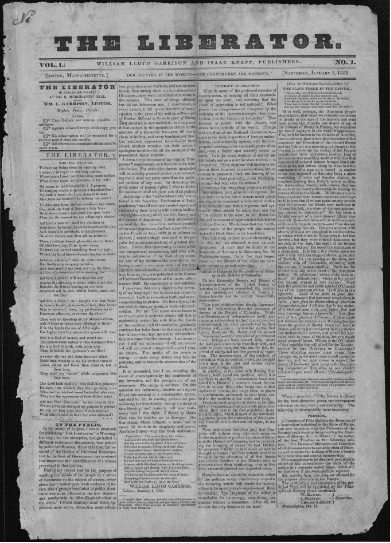
The Liberator’s “corps of Negro agents,” quoted from Quarles, Benjamin. Black Abolitionists (Cambridge, MA: Da Capo Press, 1969), p. 19.
Thomas Jefferson’s daughter Martha Randolph quoted in letter to her daughter, Virginia Randolph Trist. Folder 80, August-November, 1835, in the Nicholas Philip Trist Papers #2104, Southern Historical Collection, The Wilson Library, University of North Carolina at Chapel Hill. At the time Ellen Coolidge was making note of differences between New England and the South’s economic conditions, Bostonians were advocating for women to be educated and to gain the right to vote at the time, which stood in marked contrast to the South’s position on women’s rights. Thomas Jefferson’s granddaughters were not permitted to attend the university he founded, and women would only begin to be allowed to attend the University of Virginia in 1920, and the school would go co-ed in 1970.
Martha Jefferson Randolph as a slave holder all her life. “Will of Martha Jefferson Randolph (April 18, 1834).” Digitized and transcribed. Encyclopedia Virginia. https://encyclopediavirginia.org/entries/will-of-martha-jefferson-randolph-april-18-1834/.
Boston’s attitude that natural rights supersede Southern property rights: Kantrowitz, Stephen. More than Freedom: Fighting for Black Citizenship in a White Republic, 1829-1889 (New York: Penguin Books, 2012), p. 65.
“Vast and profound civil disobedience” for the “country’s soul” from Bordewich, Fergus M. The Underground Railroad and The War for the Soul of America (New York: Amistad, an Imprint of HarperCollins Publishers, 2005).
Racism among white abolitionists: In her work on the Grimké family of abolitionists, historian Kerry K. Greenidge discusses multi-faceted problems faced by black abolitionists working with white abolitionists. The book covers painful instances of racism experienced within the family by the formerly enslaved Grimké brothers, Archibald and Francis, and their celebrated white abolitionist aunts, Sarah and Angelina Grimké Weld. Greenidge, Kerri. The Grimkés: The Legacy of Slavery in an American Family (New York: Liveright/ W.W. Norton & Company, 2022).
Frederick Douglas as a “robber” who stole himself: Quarles, Benjamin. Black Abolitionists (Cambridge, MA: Da Capo Press, 1969), p. 63.
Also see: Douglass, Frederick. Narrative of the Life of Frederick Douglass, An American Slave Written by Himself, 1851, digitized, here: https://www.google.com/books/edition/Narrative_of_the_life_of_Frederick_Dougl/U69bAAAAQAAJ?hl=en&gbpv=1
“We went to bed one night, old-fashioned, conservative, Compromise Union Whigs, and waked up stark mad abolitionists” from: Kantrowitz, Stephen. More than Freedom: Fighting for Black Citizenship in a White Republic, 1829-1889 (New York: Penguin Books, 2012), p. 212.
“[T]hat which is not just is not law, and that which is not law, ought not to be obeyed” from The Liberator, Boston, MA, June 2, 1854. Newspapers.com.
The Haydens dusting their faces with flour: Kantrowitz, Stephen. More Than Freedom: Fighting for Black Citizenship in a White Republic, 1829-1889 (New York: Penguin Books, 2012), pp. 90-92.
Haydens as hosts for freedom seekers: Hayden, Robert C. African Americans in Boston: More Than 350 Years (Boston: Trustees of the Public Library of Boston, 1991), p.40.
The Secret Six which backed John Brown’s raid on Harper’s Ferry were Unitarian ministers, educators, and wealthy businessmen: George Luther Stearns, Franklin Sanborn, Thomas Wentworth Higginson, Samuel Gridley Howe, Theodore Parker, and Gerrit Smith.
“If the servant escape from his master, he shall dwell with thee in the city that liketh him best” from Kaplan, Sidney. “The Moby Dick in the Service of the Underground Railroad.” Phylon (1940-1956), vol. 12, no. 2, 1951, pp. 173–176. JSTOR, www.jstor.org/stable/271574. Accessed 19 Feb. 2020.
Images:
1850 Bird's Eye View of Boston. John Bachmann, Public domain, via Wikimedia Commons. http://commons.wikimedia.org/wiki/File:1850_bird%27s-eye_view_map_of_Boston_(color).jpg
Walker, David. Walker's Appeal, in Four Articles; Together with a Preamble, to the Colored Citizens of the World, But in Particular, and Very Expressly to Those of the United States of America. Written in Boston, in the State of Massachusetts, Sept. 28th, 1829. United States, David Walker, 1830. Download the full text at Google Books.
Liberator image: Yerrinton, James Brown, and William Lloyd Garrison. The Liberator. January 01, 1831. Boston, Mass.: William Lloyd Garrison and Isaac Knapp, 1831. Web. 11 Aug 2026. <https://ark.digitalcommonwealth.org/ark:/50959/mc87rk08p>.
Original Music by Al Sim
"Mystery 1"
"Mystery 3"
"The Cigarette Waltz"
"March of the War Gods"
Royalty Free Music
Courtesy Pixabay:
Music_for_Creators: "Minuet"
Rockot: "Airy Meditation"
DeusLower: "Medieval Ambient"
(No artist listed) "Dedpression"
Courtesy MusOpen:
Antonín Dvořák: Symphony No. 9 from "The New World," Op. 95:II. Largo.
Vassar: Show Notes